Several suppliers? One box.
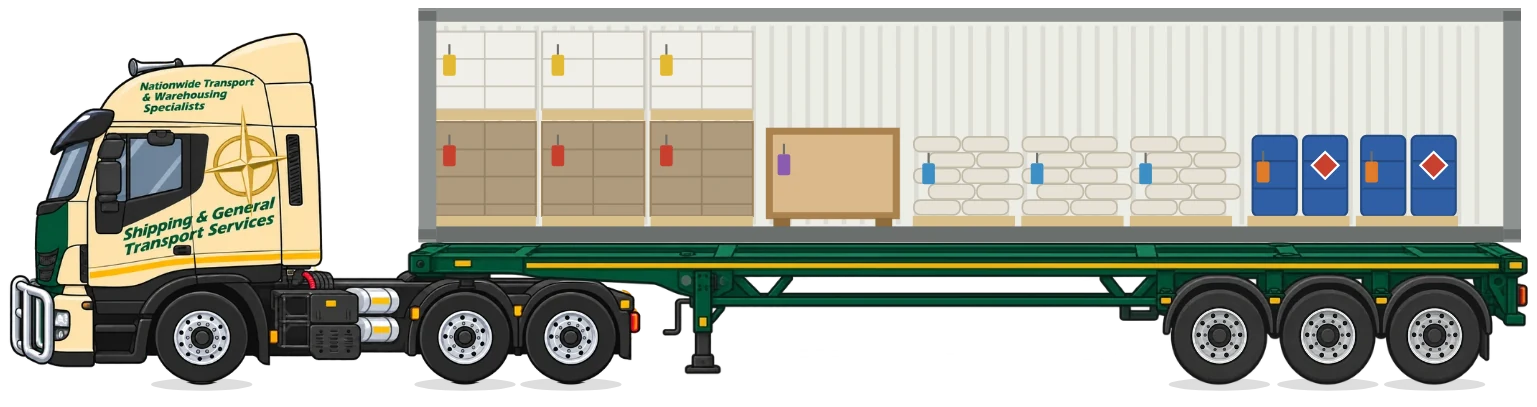
Your goods from several suppliers, packed into one export container at our Germiston depot. See the box it takes, what goes where and what can’t share it.
- 60%Of the weight in half the box, at most
- 67.7Cubic metres in a 40 ft
- N3Weighed, then down to Durban
Five suppliers, one box.
- 01
Into our depot
Collected from your suppliers in Gauteng or dropped at our Germiston depot, and held until the last one’s in.
- 02
Floor first, light on top
A’s cartons at the far end with B’s lighter ones on top, then E’s crate. Nothing heavy on anything lighter.
- 03
Spread the weight
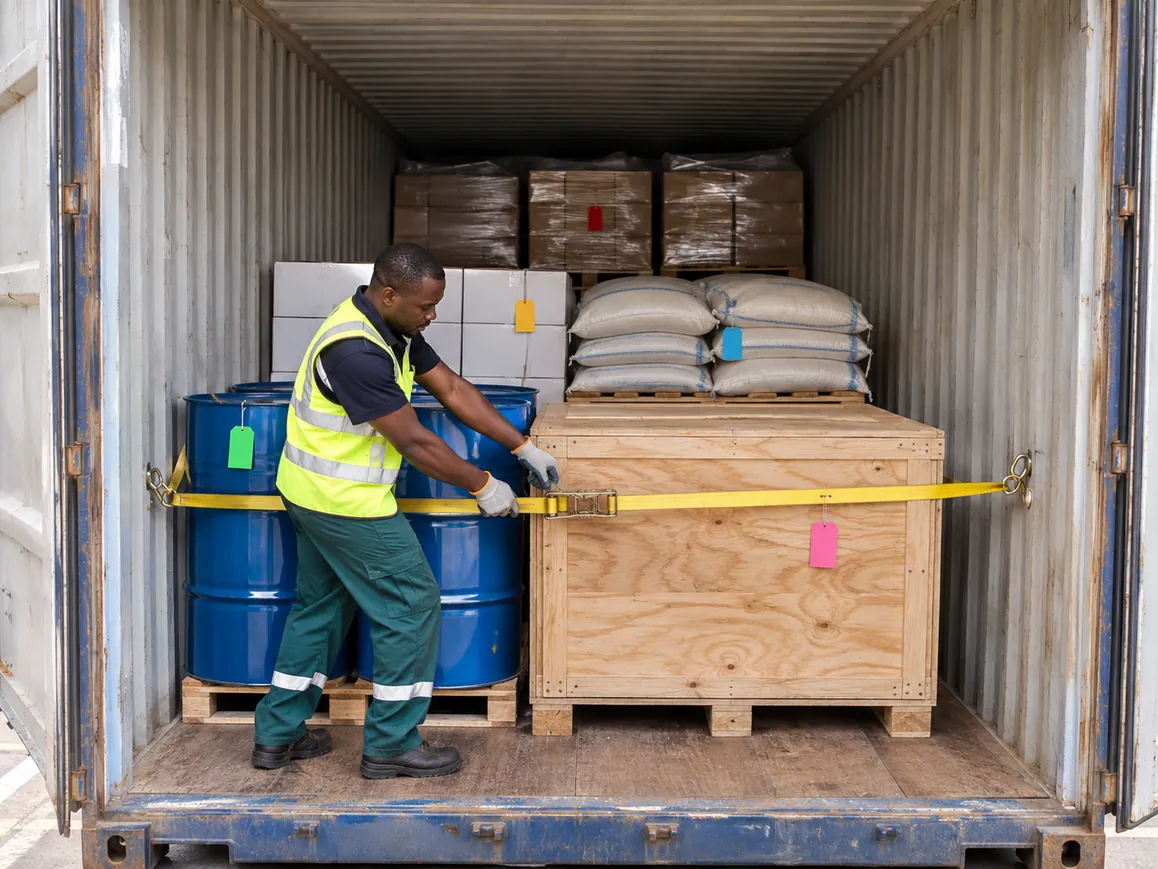
C’s sacks in the middle, D’s drums by the doors with their labels showing. The balance comes back to the middle.
- 04
Weighed, then the N3
16.5 t of cargo, sealed, weighed on our weighbridge for the VGM and on the road to Durban.
Request a quote for your box
Your box
Step 1 of 7- Suppliers
- —
- Box
- —
- To our depot
- —
- Cargo
- —
- How often
- —
- When
- —
- Box plan
- Optional
From each supplier, then at our depot
Every consignment comes with its own paperwork and its own quirks. Get the details from each supplier first, and the box is planned once, packed once and weighed once.
From each supplier
- A packing listPieces, weights and sizes
- A safety data sheetFor anything hazardous
- When it’s readyFor the collection or the drop
- The wood markedISPM 15 on pallets and crates
At our depot
- Held until it’s all inBonded or duty-free storage
- Packed at our depot10 forklifts, with the attachments
- Weighed for the VGMOur 22 m weighbridge, Method 1
- Down the N3Full containers to Durban
The weight along the box
No more than 60% of the weight in half the length, and the centre of gravity within 5% of the middle. Our weighbridge weighs the axles too, which shows uneven weight in a packed box.
What can’t share
Incompatible goods are separated or protected. Hazardous goods go by the doors, labels visible, and some must be kept from food. Anything with a strong smell stays away from goods that take it on.
One exporter, one box
This is your goods from several suppliers, shipped under your name. Several exporters sharing one box is groupage, which our site doesn’t state: ask us first.
Where we operate
Our head office and 24-hour control centre are at 69–71 Barlow Road, Jupiter, Germiston, beside our customs-licensed depot, where containers are packed, unpacked and weighed, with an office in Durban. Our full containers run the N3 between the two.
- Germiston depot69–71 Barlow Road, Jupiter, Germiston 011 873 4786
- Durban · Greyville81 Berea Road, Greyville, Durban 031 305 0438

Part of Shipping & General Transport
Shipping & General Transport is a privately owned South African logistics company built on trustworthiness, perseverance and reliability. Cargo Consolidation is one of its specialist services: your goods from several suppliers, collected or received at our depot, packed into one export box, weighed and hauled on the N3.
Visit shippingandgeneral.co.zaQuestions about one box from several suppliers
Can’t find your answer? Our team is a phone call away.
Call 011 873 4786Can you pack one export box with goods from several of my suppliers?
Yes. We collect from your suppliers in Gauteng, or they deliver to our customs-licensed depot in Germiston, and we hold the goods until the last consignment is in. Then we pack the box at the depot, weigh it for the VGM and take it down the N3 to Durban.
Do you combine several exporters’ cargo in one box?
Our site doesn’t state that kind of consolidation (groupage, or export LCL), so ask us first. This page is about one exporter’s goods from several suppliers. For imports that arrive as LCL, we collect from the unpack depots.
20 ft, 40 ft or high cube?
A 20 ft holds 33.2 m³ and carries about 28 t; a 40 ft 67.7 m³ and about 28.8 t; a high cube 76.3 m³ and about 28.6 t. Mixed sizes never fill every corner, so our plan uses 85% of the space. The box’s own plate decides the payload.
What goes on the floor and what on top?
The CTU Code, the industry’s packing code, says heavier goods never go on lighter ones, nothing heavy on fragile parcels, and liquids never on solids. So drums, machines and dense goods take the floor; light cartons go on top if the height allows. A standard box’s doors are about 2.29 m high, a high cube’s about 2.6 m.
Why does it matter where the heavy goods sit along the box?
A box is lifted level by its corners, so its centre of gravity should be within 5% of the middle. The rule of thumb: no more than 60% of the weight in either half of the length. Our weighbridge also weighs the axles, which shows uneven weight in a packed box.
Can hazardous goods go in with the rest?
Often, if they’re compatible. They go by the doors with the labels visible; the consignor declares them classified, packed and marked, and whoever packs signs the container packing certificate. Our trucks carry every class except class 1 explosives, with a Tremcard for each product. Send us each supplier’s safety data sheet first.
Can food go in the same box as chemicals or smelly goods?
Sometimes not. Some hazardous classes must be kept a set distance from food in the box, or out of it entirely, and goods with a strong smell can taint anything that takes it on. The CTU Code lets incompatible goods share only if they’re properly separated or protected. Tell us what’s in each consignment and we’ll confirm.
Do the pallets and crates need a mark?
Yes, if they’re solid wood. Wood packaging leaving South Africa must be treated and carry the ISPM 15 mark. Plywood is exempt, but solid skids under a plywood crate aren’t. Our sister site checks each piece.
Who weighs the box and declares the VGM?
You, as the shipper (or your agent), declare it; we weigh the packed, sealed box on our 22 m weighbridge and issue the VGM certificate (Method 1). Your suppliers’ weights are for planning; the weighbridge gives the figure the line needs. Our sister site works back from the stack closing.
What do you need from me?
For each supplier: who and where, the packing list (pieces, weights and sizes), what it is and whether it’s hazardous, and when it’s ready. Then the booking: the line, the vessel and the stack dates. The box plan above puts most of it in your request.
Do you do the export entry, lashing and dunnage?
Our site doesn’t state them: the export entry is your clearing agent’s, and lashing, dunnage or a stowage plan are worth confirming with us before you book.
What does it cost?
We don’t publish prices. Answer the short questions in the quote form, add your box plan if you like, and we’ll quote on your actual consignments.
How many suppliers?
Six short questions and your contact details, plus your box plan if you like. No prices online, just a quote on your actual consignments.